Dress, Field or Dive: What a Watch's Job Does to an Outfit
Every analogue watch does one of three jobs: dress, field or dive. The job it was built for decides how it looks next to your clothes, and it is a quicker guide than price or brand.
Pick a watch and an outfit in the picker to see how well they match and why. Then use the rule of thumb in each result to choose a strap, a case and a finish that fit what you already wear.
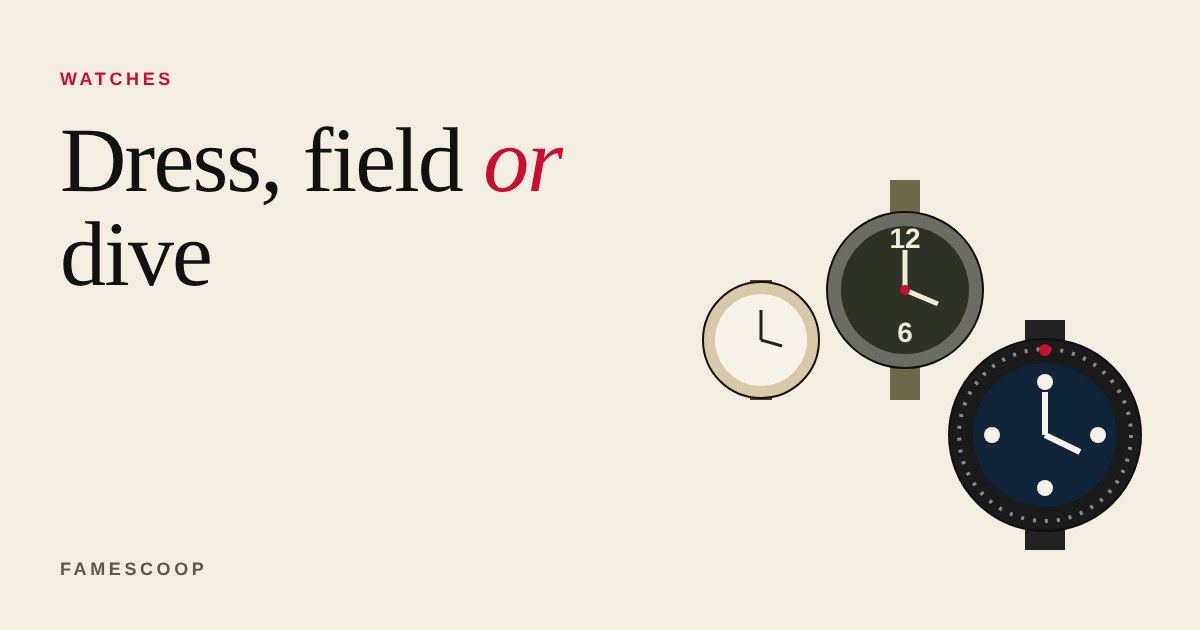
Most watch advice sorts by price or by brand. A quicker sort is by job. Three jobs explain almost every analogue watch you will see: the dress watch, the field watch and the dive watch. Each one was built for a different place, and that origin still decides what it looks like next to your clothes.
The three jobs
A dress watch is made to disappear under a cuff. It is thin, the case is usually plain polished metal, the dial is clean with few markings, and the strap is most often smooth leather. Everything is chosen to keep the watch quiet and slim.
A field watch comes from the military habit of needing to read the time at a glance, in poor light, without thinking. That gives it a matte or brushed case, a dial with big Arabic numerals (the 1, 2, 3 kind), and a strap that is happy to get scuffed: canvas, woven nylon or rugged leather.
A dive watch is built to be read underwater. The international standard for diver's watches, ISO 6425, sets minimums that include water resistance of at least 100 metres and a rotating bezel (the ring around the glass) that turns one way only. Add thick luminous markers and a sturdy case and you get a watch that looks bold from across a room.
Match the job to the outfit
The pairings in the picker follow one idea: watch and clothes should share a level of formality. Tailoring is smooth and structured, so a slim, smooth watch sits well with it. Knitwear, denim and canvas are textured and relaxed, so a matte, sturdy field watch feels at home. Technical fabrics and sporty shoes are built for weather, so a dive watch joins the same practical team.
That is why a thick diver feels off under a suit cuff: the case is bigger than the gap, and it has to push the sleeve up. And it is why a fragile-looking dress watch seems out of place on a hiking trip. Neither is wrong. They just send a different message.
Size matters here too, in a neutral way: a watch of around 36 to 40 mm across suits most cuffs, while 44 mm and above is a statement piece whatever the job. Check the number in the listing before you check the dial.
The middle road
You do not need three watches. Several designs sit between the types, and one of them covers most of a week:
- A slim field watch on a leather strap works with a jacket and with jeans.
- A dress watch on a canvas or nylon strap gets more relaxed in one swap. Straps are cheap and easy to change.
- A diver on a plain steel bracelet looks smarter than the same watch on rubber.
The strap changes the type faster than the case does.
If you already own one watch, try it against all three outfits above. You will quickly see which jobs it can do and which it cannot, and that tells you more than any list of models.
How to wear it
Whatever you choose, a few habits help. Let the watch sit just behind the wrist bone, so it does not slide around. Check that the cuff can move over the case, or leave the sleeve pushed up on purpose. Keep metals in one family where you can: a steel watch, steel buckle and steel hoop tend to look settled together, while mixing warm gold with cool silver looks best when it is clearly deliberate.
Wearing what you already own is the most sustainable choice, and second-hand watches and straps are a good way to try a new job without paying new prices. A reliable quartz watch is usually enough for any of these roles; a mechanical movement is a pleasure rather than a requirement.
What to look for
- Case thickness for dress, dial legibility for field, bezel and water resistance for diving.
- Finish: polished for dressy, matte or brushed for everyday.
- Strap: leather moves a watch up the dress scale, canvas or rubber moves it down.
- Case size against your cuff: if the sleeve will not close over it, choose a slimmer case or push the sleeve up with intent.